


Is your homemade oat milk too slimy? You’re doing it wrong
Martin Sundberg | | 3 minutes
Homemade oat milk that turns thick and sticky instead of creamy and smooth. It’s the most common problem when making oat milk at home, and almost everyone comes up against it. The result looks more like wallpaper paste than something you’d want to pour into your coffee. The problem isn’t the oats. It’s how you handle them. You can completely prevent it from becoming slimy once you understand what’s going wrong.
Why does oat milk become slimy?
Oats are full of starch. That starch gives oat milk its creamy body, but it has one enemy: heat. As soon as starch gets warm, it absorbs water and swells up. It’s the same principle as with porridge: it becomes thick and sticky.
When making oat milk, heat can be generated in two ways. The first is using hot water. The second is less obvious: blending for too long. A blender generates frictional heat, and after two minutes of blending, the mixture is already a few degrees warmer. Enough to activate the starch.
The type of oats also plays a role. Instant oats are pre-processed and release starch more quickly than regular oat flakes. And squeezing too hard when straining squeezes extra starch out of the pulp, straight into the milk.
Hot water, blending for too long, and squeezing hard when straining. Three mistakes that are often made simultaneously, and which together result in that wallpaper paste texture.
Five adjustments that make all the difference
The solutions are simpler than you might expect.
- Use cold water - This is the most important adjustment. Cold tap water works; ice-cold water works even better. Some people add ice cubes to the blender. The difference compared to warm water is immediately noticeable.
- Blend briefly - Twenty to thirty seconds on high speed is enough to grind the oats finely. Anything longer generates frictional heat and activates the starch. It feels like too little, but it isn’t.
- Use regular oat flakes, not instant - Instant oats (quick-cook oats) are pre-steamed and rolled thinner. They break down more quickly and release more starch. Regular oat flakes are more stable. Whether organic or not makes no difference to the texture; it’s all about the type of flake.
- Don’t squeeze when straining – It’s tempting to squeeze everything out of the pulp, but every time you squeeze, you lose starch. Let gravity do the work. That means a slightly lower yield, but a smoother milk.
- Do not soak the oats - Soaking is useful for nuts. With oats, it has the opposite effect. Soaking activates the starch and produces precisely the gelatinous texture you want to avoid.
The right ratio
Even with the right technique, too many oats can make the milk too thick. The ratio that works well is 60 to 80 grams of oat flakes per litre of water. On the lower side for coffee creamer (thinner, mixes better with coffee), on the higher side for a creamier result with muesli or for drinking on its own.
Above 100 grams per litre, it almost always becomes too thick.
Improving the flavour
Oat milk made from just oats and water tastes bland. A few additions help without ruining the texture.
A quarter of a teaspoon of salt per litre makes a noticeable difference. Without salt, oat milk tastes bland or slightly bitter. With salt, the flavour becomes rounder and fuller.
A tablespoon of neutral oil (sunflower or rapeseed) adds more body. This is also what manufacturers do: almost every carton of oat milk from the supermarket lists oil in the ingredients. An added bonus: with oil, the milk froths up slightly better in coffee.
For sweetness, a date, a teaspoon of maple syrup or vanilla extract works well. Add before blending so that it is well distributed.
With a milk maker
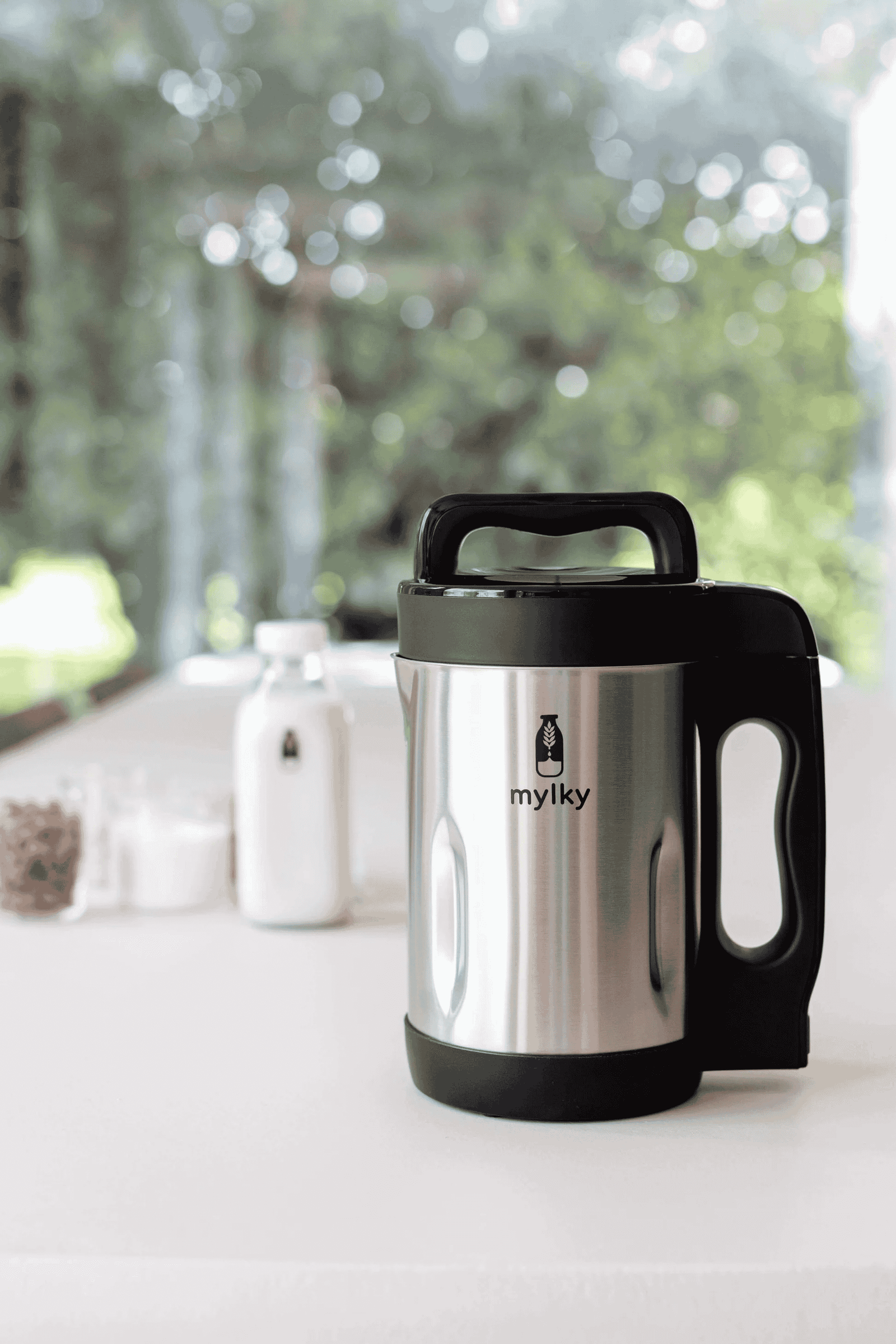
The tips above are aimed at the blender method. With a milk maker such as Mylky, things are different. The machine blends and filters in a single step, without the use of heat. The starch activation caused by frictional heat, which occurs with a blender, plays a much smaller role here. Straining and squeezing are not necessary, and these are precisely the steps where things most often go wrong with the blender method.
The basic rules still apply: cold water, plain oat flakes, and not too many oats. The machine won’t solve the problem if the ingredients aren’t right.
Already slimy? Don’t throw it away
Once slimy, always slimy. The starch has been activated and that cannot be reversed.
What you can do: use the batch for something else. In pancake batter or smoothies, the texture isn’t noticeable. Porridge is thick anyway. Throwing it away is a waste; making it again with the right approach is the better option.
In conclusion
Slimy oat milk isn’t a matter of bad luck or poor-quality oats. It’s almost always a combination of water that’s too hot, blending for too long, and straining too vigorously. Adjust those three things and the result is immediately different.
It might take two or three batches to find the right ratio and routine. But once you’ve got it right, homemade oat milk is easier than it seems.
Share


Martin Sundberg
What began in Martin Sundberg’s kitchen with a blender and a handful of nuts grew into Mylky – his way of making plant-based milk fun, tasty and mindful once again.
Related Articles
-

Is your homemade oat milk too slimy? You’re doi...
Martin SundbergPrep Time:
Servings:
Is your homemade oat milk too slimy? You’re doing it wrong
Martin Sundberg -

Plant-based milk for coffee: which one should y...
Martin SundbergPrep Time:
Servings:
Plant-based milk for coffee: which one should you choose?
Martin Sundberg -

Frothing plant-based milk: How to get a good froth
Martin SundbergPrep Time:
Servings:
Frothing plant-based milk: How to get a good froth
Martin Sundberg


