


What types of plant-based milk are there?
Martin Sundberg | |
The question, ‘Which plant milk is best?’ is a bit like asking which shoe is best. It depends on where you're going.
Here's the thing: today, you can make milk from almost anything. Nuts, grains, seeds, legumes – just add water and blend. But not all plant milks behave the same way. One foams perfectly in a cappuccino, another becomes slimy in coffee. One is rich in protein; another is mostly sugar water.
In this article, I'll go through the primary types of plant-based milk. You won't get any recipes here — although I'll link to them — but what you will get is the lowdown on their characteristics, why you use them and how they actually taste. I've tried them all by now, and some were...let´s say… interesting!
What types of plant-based milk are there, really?
I've divided them into three categories.
- Mainstream favourites: Available in every grocery store. Versatile and popular for a reason.
- Rising stars: Newer, but increasingly common. Early adopters love them.
- Specialities: For specific needs or uses.
For each type of milk, I present:
- Key characteristics
- Flavour profile
- When and why to buy (or why not)
- Link to the Mylky recipe if you want to make it yourself
It bears repeating, there is no ‘best’ choice in general. It all depends on what you want to use the milk for. I myself switch between different varieties depending on the purpose.
Mainstream favourites
These are the varieties you see everywhere. They are popular because they work in most situations..
Oat milk – the coffee specialist
If any plant-based milk has become as mainstream as cow's milk, it's oat milk This is for a good (!) reason: it foams like a dream.
Flavour profile: Mild, slightly sweet, subtle cereal notes. The natural sweetness comes from the starch in the oats – some people appreciate it, others don't notice it.
Nutritional value: Approximately 1–1.5 g of protein per 100 ml, but about 6–7 g of carbohydrates. Good to know if you're monitoring your blood sugar.
Perfect for:
- Coffee – Lattes and cappuccinos become creamy with a fine foam
- Smoothies – Light sweetness without overpowering
- Cereal, granola and porridge – An obvious combination
- Baking – Works in most things
Less suitable for:
- Savoury sauces (unless you want a slightly sweet tone)
- When you want to maximise protein
Good to know: Over-blended oat milk can become slimy due to the starch. With Mylky (60 seconds), it's fine; if you're blending manually, keep it short.
Mylky recipe: Make oat milk
Almond milk – the lightweight
Almond milk is hugely popular because it is so light. Think of it as the plant-based equivalent of low-fat milk. Few calories per glass make it a favourite for those who count calories. But remember: commercial almond milk often contains only 2–5% almonds. The rest is water and additives.
Flavour profile: Subtly nutty, slightly sweet. Store-bought varieties are often watery, while homemade (with plenty of almonds) is creamy and distinctly nutty.
Nutritional value: Often 15–20 kcal per 100 ml – but almost no protein (0.3–0.5 g). Homemade with a high nut content is significantly more nutritious.
Perfect for:
- Light, fruity smoothies
- Cereal and granola
- Light desserts
- Calorie control
Less suitable for:
- Coffee – tends to separate
- Savoury dishes – the flavour rarely suits
- When you want protein
Good to know: The difference between shop-bought and homemade is huge. The first time I made 100+ g almonds/litre, I was amazed – it was a completely different product.
Mylky recipes:
Soya milk – the protein champion
Soy milk is the original plant-based milk. It has been around for a long time and is the only one often mentioned in ‘official guidelines’. 3–4 g of protein per 100 ml makes it most similar to cow's milk.
Flavour profile: Slightly beany, creamy, relatively neutral. The beaniness is a matter of habit – some people get used to it quickly, others don't.
Nutritional value: Highest protein and complete amino acid profile. Contains no natural sugars (unless added).
Perfect for:
- Universal use – baking, cooking, smoothies, coffee, etc.
- When you want protein
- 1:1 replacement for cow's milk in recipes
- After exercise
Less suitable for:
- If you dislike the taste of beans
- Allergy or intolerance to soy
Good to know: Raw soy milk is neither tasty nor suitable – it must be heated to inactivate certain substances. With Mylky, this is quick, but boil it briefly afterwards. We explain more in the recipe.
Mylky recipe: Make soy milk
Cashew milk – the creamy secret weapon
Cashews are not the most protein-rich, but their creaminess is hard to beat. The buttery texture works wonders in the right context.
Flavour profile: Mild, softly nutty, almost buttery. Suitable for just about anything.
Nutritional value: Approximately 1 g of protein per 100 ml, and healthy fats, with calories increasing with creaminess.
Perfect for:
- Creamy sauces – pasta, curries, soups
- Coffee, as it is creamy without being heavy
- Desserts – puddings, ice cream, mousse
- When you want richness
Less suitable for:
- Those who want to keep their energy intake down
- Nut allergies (technically a seed, but often treated as a nut)
Good to know: Cashews do not need to be soaked – easier than almonds.
Mylky recipe: Make cashew milk
The rising stars
Some varieties that are quickly gaining ground – each with its own superpower.
Coconut milk – the tropical (but...)
Here we mean drinkable coconut milk, not the thick canned variety used for cooking.
Flavour profile: Distinct coconut, sweet and tropical. You either love it or you don't – rarely anything in between.
Nutritional value: The drinkable variety is surprisingly light (unlike the canned variety). Around 20 kcal per 100 ml, low in protein.
Perfect for:
- Tropical smoothies
- Asian-inspired dishes
- Matcha latte – works well with sweetness
- When you love coconut flavour
Less suitable for:
- Neutral coffee as it overpowers it
- Western savoury dishes
- If you don't like coconut
Worth knowing: I use it for variety, not on a daily basis. And again, it's not to be confused with coconut milk (or coconut cream!) in a can.
Mylky recipe: Make coconut milk
Pea milk – the fitness favourite
Relatively new – particularly popular with many who exercise thanks to 2–3 g of protein per 100 ml and virtually zero carbohydrates.
Flavour profile: Surprisingly neutral and mild. Made from yellow peas (not green ones from the freezer).
Nutritional value: High protein, good amino acid profile, almost no carbohydrates.
Perfect for:
- Consumption after training
- Coffee (surprisingly good)
- Low-carbohydrate diet with a focus on protein
- Savoury dishes
Less suitable for:
- Those who want something easily accessible, as it is not yet available everywhere
- A little trickier to make at home
Worth knowing: Brands such as WUNDA and Sproud have taken the lead. Of course, it is possible to make your own with Mylky.
Mylky recipe: Make pea milk
Hemp milk – a taste to get used to
No, no intoxicating effect (0% THC). But the taste is... special – in a good way once you get used to it.
Taste profile: Earthy, grassy, nutty. An acquired taste – but rewarding.
Nutritional value: Approx. 2 g protein per 100 ml, complete amino acid profile, both omega-3 and omega-6. Nutritious.
Perfect for:
- Green smoothies where the earthiness fits
- Porridge with banana and cinnamon
- If you are considering the ratio between omega-3 and omega-6
- Savoury dishes
Less suitable for:
- Coffee, as the flavours clash
- Desserts – the earthiness is distracting
- If you dislike strong flavours
Worth knowing: Give it a few weeks. If you don't like it, obviously don't force yourself.
Mylky recipe: Make hemp milk
The specific varieties
Not for everyone, but invaluable in the right situations.
Rice milk – the allergy-safe friend
Not the most nutrient-dense, but the least allergenic: no gluten, no nuts, no soy. Often rice milk is the only option for people with multiple allergies.
Flavour profile: Sweet, watery, neutral. Quite sweet – the sugars in the rice are released when blended.
Nutritional value: Low protein (0.3–0.5 g), high carbohydrate content (9–10 g per 100 ml).
Perfect for:
- People with multiple allergies
- Children who like sweet flavours (but don't overdo it because of the arsenic in rice)
- When nothing else works
Less suitable for:
- Focus on protein requirements
- Low-carbohydrate diets
- Most everyday purposes
Worth knowing: Can be seen as an emergency option if you have no other choice.
Mylky recipe: Make rice milk
Macadamia milk – the luxury option
A bit like the French champagne of plant-based milks: delicious and expensive. And creamy (so it's not really champagne anymore!).
Flavour profile: Rich, subtly sweet, buttery. Pure luxury.
Nutritional value: Low in protein, but good fats. Calorie-rich if you make it creamy.
Perfect for:
- Desserts to impress
- Luxury coffee as a treat
- Special occasions
Less suitable for:
- Daily use (unless you have a generous budget)
- Protein focus
Worth knowing: Macadamia nuts are expensive – both in a ready-made milk and as a raw ingredient. More of a treat than an everyday product.
Mylky status: No recipe of its own, but you can easily use the base from almond milk with macadamia.
A quick comparison
| Milk type | Protein (per 100 ml) | Calories (per 100 ml) | Main advantages | Note |
|---|---|---|---|---|
| Soy milk | 3–4 g | 40–50 | Universal & protein | Bean flavour |
|
Pea milk |
2–3 g | 25–30 | Suitable for training & low-carb diets | Not widely available yet |
| Hemp milk | 2 g | 30–40 | Omega ratio & green smoothies | Earthy flavour |
| Oat milk | 1–1,5 g | 40–50 | Coffee & baking | Carbohydrates |
| Cashew milk | 1 g | 40–60 | Creamy sauces | Calorie content |
| Almond milk | 0,3–0,5 g | 15–20 | Smoothies & light | Low protein |
| Coconut milk | 0,3–0,5 g | 20 | Tropical smoothies | Strong flavour |
| Rice milk | 0,3–0,5 g | 45–50 | Allergies | High sugar content |
| Macadamia milk | ~0,5 g | 50–70 | Luxury treats | Expensive |
Suitable for...?
Not all plant-based milks are suitable for everything. Here is a quick guide.
For coffee
| Milk type | Suitability | Why? |
|---|---|---|
| Oat milk | ⭐⭐⭐⭐⭐ | Best foam, most stable |
| Almond milk (Barista) | ⭐⭐⭐⭐ | Works when made creamy |
| Cashew milk | ⭐⭐⭐⭐ | Nice creaminess |
| Pea milk | ⭐⭐⭐ | Surprisingly okay |
| Soy milk | ⭐⭐⭐ | Works, not magical |
| Coconut milk | ⭐ | Overpowers the flavour |
| Hemp milk | ⭐ | Flavour clash |
For smoothies
| Smoothie type | Best match | Why? |
|---|---|---|
| Fruity & light | Almond milk | Light, fresh |
| Creamy & dessert-like | Cashew milk | Velvety texture |
| Energy & breakfast | Oat milk | The carbohydrates help |
| Green & nutritious | Hemp milk | Omega ratio & earthiness |
| Tropical | Coconut milk | Flavour match |
For baking
| Milk type | Suitability | Why? |
|---|---|---|
| Soy milk | ⭐⭐⭐⭐⭐ | Best 1:1 substitute |
| Oat milk | ⭐⭐⭐⭐ | Works in most things |
| Almond milk | ⭐⭐⭐ | Lighter & airier |
| Coconut milk | ⭐⭐ | Only if you want coconut flavour |
For savoury dishes
| Milk type | Suitability | Why? |
|---|---|---|
| Cashew milk | ⭐⭐⭐⭐⭐ | Creamy sauces/soups |
| Soya milk | ⭐⭐⭐⭐ | Neutral and stable |
| Pea milk | ⭐⭐⭐⭐ | Suitable for savoury profiles |
| Oat milk | ⭐⭐ | Mostly for sweet dishes |
| Coconut milk | ⭐⭐ | Mainly Asian dishes |
Make it yourself or buy it?
This is perhaps the most important question to consider if you take plant-based milk seriously. There are significant differences between homemade and shop-bought – in price, taste and content.
What do you get when you make it yourself?
- Much higher proportion of raw ingredients
- Shop-bought almond milk: 2–5% almonds.
- Homemade: definitely 10% or more. The difference in taste and texture is enormous. The same applies to oats, cashews and others.
- No unnecessary additives
- Purchased: water, 2% raw ingredients, oil, stabilisers, emulsifiers, fortification.
- Homemade: raw ingredients + water (+ possibly a pinch of salt/date sweetener).
- Fresh tastes better – Creamier texture and clearer raw ingredient flavour.
- Significantly cheaper – The approximate price per litre for plant-based milk is between 20 and 40 Swedish kronor, while homemade milk costs a few kronor.
...but there are disadvantages
- Shelf life – Homemade lasts 3–5 days. An unopened bought package lasts for months.
- No vitamin/mineral fortification – Calcium/B12/D are not automatically added (unless you do it yourself).
- Planning – You need to make new batches in time.
- May separate in coffee – Without stabilisers, it can separate, especially in hot/acidic coffee (happens more often with almonds than oats).
The solution: Mylky
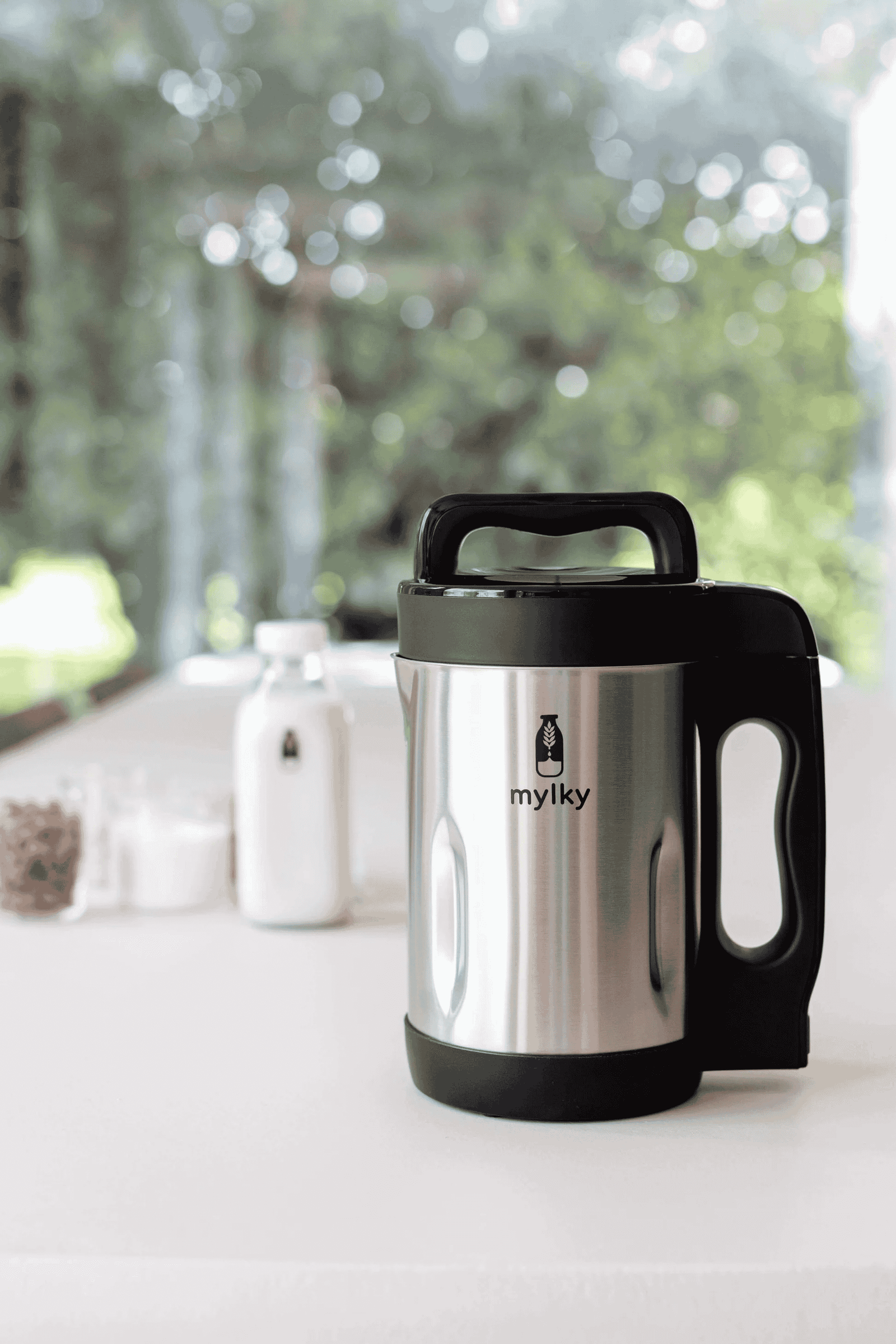
Why did I create Mylky? Among other things, because it eliminates the biggest disadvantage of making your own – the time and hassle of soaking, blending, straining.
With Mylky, you can make fresh plant milk in 60 seconds. Add oats/almonds/cashews, etc., press the button – done. No strainer, no hassle.
I now make fresh milk regularly because it literally takes a minute. When I blended and strained by hand, I rarely got around to it – and the cartons crept back in.
Is it worth the investment?
It depends on consumption. If you use plant-based milk daily – in coffee, smoothies, baking, etc. – it often pays for itself in a few months in saved purchases. If you rarely use milk, the shop-bought product is perfectly fine.
Take a look at how Mylky works here and see if it's right for you.
So, which plant-based milk is ‘best’?
Basically, it all comes down to this: The best plant-based milk is the one that works best for your needs.
- Perfect coffee – Oats
- Protein – Soy or peas
- Few calories – Almond
- Creaminess – Cashew
- Luxury – Macadamia
Perhaps, like me, you'll end up using different varieties for different purposes. It's not really complicated – it's smart.
The great thing about plant-based milk, especially when you make it yourself, is the freedom to experiment. Try different combinations. Oats + cashew for extra creamy coffee milk. Almond + a little coconut for a tropical twist. Play around!
My final tip: Start with the variety that best suits your main purpose. Give your taste buds a few weeks to enjoy it. Then move on and try something new. You will find your favourites.
And remember: If something doesn't work for you, that's totally fine. Not everything has to be a favourite.
Now it's your turn
What's your go-to plant milk? Have you found any unexpected combinations? Or are you still looking for the perfect match?
If you liked the guide and want to get started, check out Mylky. It takes about 60 seconds — fresh milk, zero hassle. That's the whole reason I'm hooked on it.
Happy blending! ☕🥛
Share


Martin Sundberg
What began in Martin Sundberg's kitchen with a blender and a handful of nuts grew into Mylky – his way of making plant-based milk fun, tasty and conscious again.
Related Articles
-

How long does homemade plant milk last?
Martin SundbergPrep Time:
Servings:
How long does homemade plant milk last?
Martin Sundberg -

CO2 footprint: plant milk vs. cow's milk
Martin SundbergPrep Time:
Servings:
CO2 footprint: plant milk vs. cow's milk
Martin Sundberg -

Plant milk machine or blender: which is better?
Martin SundbergPrep Time:
Servings:
Plant milk machine or blender: which is better?
Martin Sundberg


